
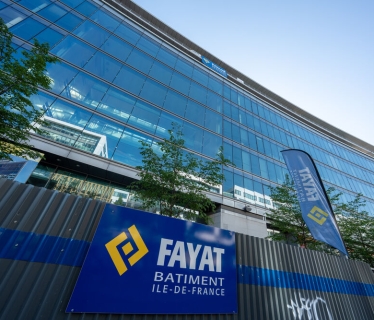
"Jin Social Club is above all driven by one ambition: adapting existing buildings to meet new environmental challenges and the constantly evolving needs of the commercial property sector," explains Manuel B., who oversees the coordination of the project for Fayat Bâtiment Île-de-France. With a total floor area of 44,000 m², including 24,000 m² of office space, Jin Social Club is breathing new life into a strategically located property complex, creating a more cohesive and functional environment.
Rather than rebuilding from scratch, Fayat Bâtiment is restructuring, upgrading and optimising the existing building. The building's lower levels have been completely redesigned to accommodate a range of shared facilities, including a work café, business centre, staff restaurant and auditorium. These spaces are designed to encourage collaboration and enhance the workplace experience.
On the upper floors, flexible office layouts can accommodate one or several organisations. Terraces on the seventh and eighth floors complete the development, providing additional comfort and attractive outdoor spaces for building users.
A commitment to material reuse
From the earliest design stages, Fayat Bâtiment placed systematic material reuse at the heart of the project. Raised access floors, metal ceilings, service ducts, doors and sanitary equipment have been retained, inspected and reintegrated into the refurbished building.
This approach, still relatively uncommon in commercial building refurbishment, has been implemented with meticulous planning and rigorous execution.
"The first phase of the project was entirely dedicated to assessments and developing the material reuse strategy. It requires extremely precise forward planning, but it is now our greatest source of pride," explains Manuel B.
Beyond reducing the consumption of new materials, this approach represents a significant shift in mindset for all the teams involved.
Exceptional execution in a challenging environment
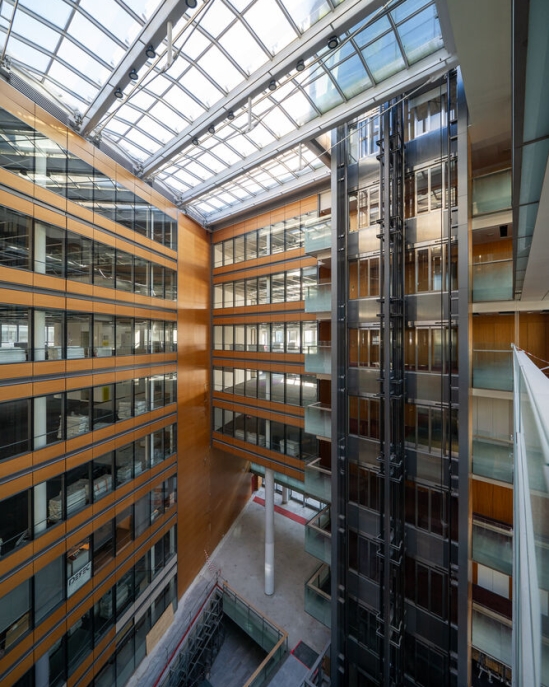
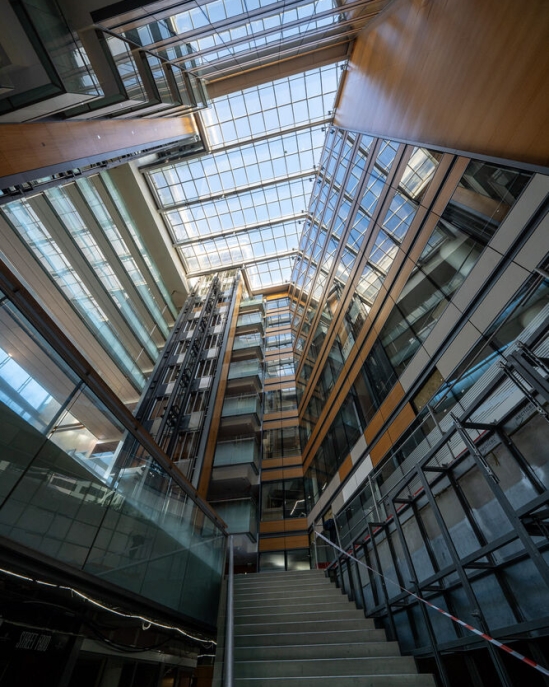
The complexity of the project lies not only in its architectural ambitions but also in the need to carry out construction works alongside ongoing building operations: car parks remaining in use, restaurants staying open and circulation routes being maintained.
Every intervention is carefully planned, with each construction activity requiring a delicate balance between technical precision and consideration for building users.
"The installation of two monumental staircases in the atrium, the creation of new floor openings to accommodate circulation routes, and the integration of lifts into the façades all demonstrate our ability to work precisely within the constraints of the existing building," adds Manuel B.
A highly intricate operation requiring exceptional precision on the scale of a major office building.
A strong and exemplary collaborative approach
Above all, the success of this complex operation relies on a closely coordinated team.
"On average, nearly 180 construction workers will be working on site between September and January 2026." This carefully structured organisation is one of the key factors behind the quality of execution. Beyond the number of people involved, however, it is the collective expertise and commitment of the teams that truly drive the project forward. The success of Jin Social Club is built on clear project governance and a strong culture of collaboration. Led by Fayat Bâtiment Île-de-France as the main contractor, the project is being delivered on behalf of PIMCO, a subsidiary of Allianz Real Estate. As a demanding client, PIMCO has placed its trust in Fayat Bâtiment's technical expertise and responsible construction solutions.
"Working closely with GEMO, the project management team responsible for overseeing construction, Fayat Bâtiment has brought together a network of committed partners, starting with Spie Building Solutions, which has been involved since the design phase to develop and implement the building's technical installations," explains Manuel B. Other specialist contractors, particularly in building strip-out, joinery and structural works, have also contributed to the project's successful coordination. Each partner has brought precision, flexibility and high standards of workmanship to this complex operation. This collaborative approach, based on mutual respect and joint design development, demonstrates a different way of managing construction projects.
Jin Social Club therefore stands as an example of effective operational collaboration, supporting a responsible approach to transforming existing buildings. The project further strengthens Fayat Bâtiment Île-de-France's position as a leading player in building refurbishment and low-carbon construction.
A landmark project
Scheduled for completion in February 2026, Jin Social Club will mark the culmination of two years of carefully planned and meticulously executed transformation.
The project demonstrates that a building does not need to be new to achieve exemplary standards. What matters is rethinking existing structures with a clear strategy and a strong commitment to sustainability.